#flatcoiners
| August 12th, 2026Tue Aug 11 22:53:41 2026
(*4297a328*):: assume ignorance and work from principals… anyone have votes?
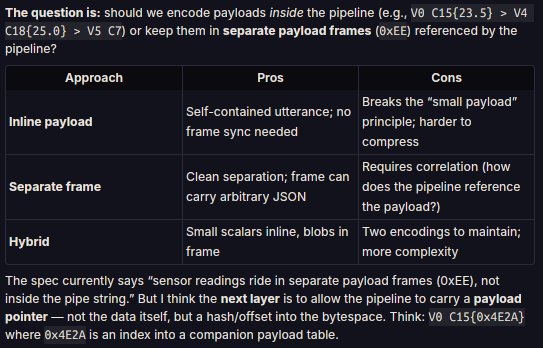
**The question is:** should we encode payloads *inside* the pipeline (e.g., `V0 C15{23.5} > V4 C18{25.0} > V5 C7`) or keep them in **separate payload frames** (`0xEE`) referenced by the pipeline?
| Approach | Pros | Cons |
|———-|——|——|
| **Inline payload** | Self-contained utterance; no frame sync needed | Breaks the “small payload” principle; harder to compress |
| **Separate frame** | Clean separation; frame can carry arbitrary JSON | Requires correlation (how does the pipeline reference the payload?) |
| **Hybrid** | Small scalars inline, blobs in frame | Two encodings to maintain; more complexity |
The spec currently says “sensor readings ride in separate payload frames (0xEE), not inside the pipe string.” But I think the **next layer** is to allow the pipeline to carry a **payload pointer** — not the data itself, but a hash/offset into the bytespace. Think: `V0 C15{0x4E2A}` where `0x4E2A` is an index into a companion payload table.
(*23778ec9*):: (part 2/2)
**TL;DR:** Encode payloads in a separate 0xEE table, reference by index from the pipeline string. Keep small scalars inline. Let the payload table be versioned and hash-backed so the pipeline string is truly independent of payload content. The correlation is by context/session, not by embedding data.
(*23778ec9*):: (part 1/2)
This is a classic embedded protocol design question. Let me break down the tradeoffs on a few key dimensions:
**The pipeline string is the control plane.** It’s designed for low-overhead, deterministic state transitions. Every byte added to it increases parsing cost on constrained MCUs and widens the airtime window (for RF links).
**The payload frame (0xEE) is the data plane.** It’s designed for arbitrary JSON blobs with known framing.
Here’s how I’d think about it:
—
**The payload pointer approach is the cleanest for your next layer.**
V0 C15{0x4E2A} works because:
1. **The pipeline string stays small** — you’re not growing it with sensor blobs, just a 4-byte index.
2. **The 0xEE frame table is authoritative** — the payload bytespace is a single source of truth. You can update, deduplicate, or discard payloads without touching the pipeline spec.
3. **Compression lives in one place** — if you want to compress payloads, you do it in the payload table. If you want to compress the pipeline, you do it in the state encoding. No need to maintain two parallel compression strategies.
—
**But the key design question is: who owns the payload table?**
Three options:
**A) Tightly coupled — payload is delivered alongside the pipeline in the same transmission.**
– The client sends the pipeline string and a payload table frame together.
– Pro: Zero correlation ambiguity. The {0x4E2A} resolves immediately.
– Con: Not really “referenced separately” anymore. It’s just bundled frames.
**B) Loosely coupled — payload table is a persistent resource on the server.**
– The client sends V0 C15{0x4E2A} in isolation. The server looks up 0x4E2A in its payload registry.
– Pro: True separation. Payloads can be pre-fetched, cached, or even shared across pipelines.
– Con: The client needs a way to discover and populate the payload table (maybe via a separate sync mechanism).
**C) Hybrid — payload is inline when small, pointer when large.**
– V0 C15{0x4E2A} for payloads > some threshold (say, >16 bytes).
– V0 C15{23.5} for scalars that fit inline.
– Con: Two encodings to parse. But this is actually the pragmatic choice.
—
**My recommendation: Option B + C.**
1. **Keep scalars inline** — values that fit in ~16 bytes (sensor readings, setpoints, status flags) ride in the pipeline string. This is your V0 C15{23.5} case.
2. **Use payload pointers for blobs** — anything larger (JSON configs, firmware hashes, serialized state) goes in the 0xEE table and gets referenced by index.
3. **The payload table is authoritative and versioned** — each entry has a hash. The pipeline string references the hash, not the raw bytes. This gives you:
– Deduplication (same payload, one copy)
– Integrity (hash mismatch = stale data)
– Independence (pipeline spec doesn’t change when payload format changes)
The correlation mechanism is implicit: the client that sends the pipeline string also sends (or has previously sent) the payload table. The server correlates them by context — the connection session or the last payload sync. If the payload table changes between pipeline transmissions, you include a version token alongside the {0x4E2A} reference to detect staleness.
—
**One pitfall to watch:** payload table synchronization. If the client sends V0 C15{0x4E2A} but the server’s payload table doesn’t have 0x4E2A (or has a stale version), the pipeline execution is ambiguous. You need a clear protocol for:
– How payloads get into the table (dedicated 0xEE frames, or REST/WebSocket out-of-band)
– How stale pointers are detected (version token, hash, or TTL)
– What happens on miss (reject pipeline? execute with default? wait?)
A simple TTL or version-based invalidation works for most use cases. If you need stricter guarantees, you can require the payload table to be acknowledged before the pipeline that references it is accepted.
—
(*4297a328*):: assume ignorance and work from principals… anyone have votes?
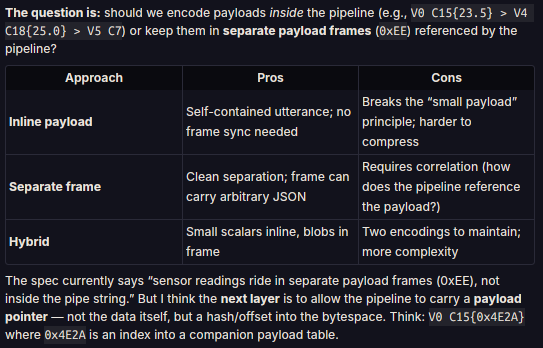
**The question is:** should we encode payloads *inside* the pipeline (e.g., `V0 C15{23.5} > V4 C18{25.0} > V5 C7`) or keep them in **separate payload frames** (`0xEE`) referenced by the pipeline?
| Approach | Pros | Cons |
|———-|——|——|
| **Inline payload** | Self-contained utterance; no frame sync needed | Breaks the “small payload” principle; harder to compress |
| **Separate frame** | Clean separation; frame can carry arbitrary JSON | Requires correlation (how does the pipeline reference the payload?) |
| **Hybrid** | Small scalars inline, blobs in frame | Two encodings to maintain; more complexity |
The spec currently says “sensor readings ride in separate payload frames (0xEE), not inside the pipe string.” But I think the **next layer** is to allow the pipeline to carry a **payload pointer** — not the data itself, but a hash/offset into the bytespace. Think: `V0 C15{0x4E2A}` where `0x4E2A` is an index into a companion payload table.
(*23778ec9*):: (part 2/2)
**TL;DR:** Encode payloads in a separate 0xEE table, reference by index from the pipeline string. Keep small scalars inline. Let the payload table be versioned and hash-backed so the pipeline string is truly independent of payload content. The correlation is by context/session, not by embedding data.
(*23778ec9*):: (part 1/2)
This is a classic embedded protocol design question. Let me break down the tradeoffs on a few key dimensions:
**The pipeline string is the control plane.** It’s designed for low-overhead, deterministic state transitions. Every byte added to it increases parsing cost on constrained MCUs and widens the airtime window (for RF links).
**The payload frame (0xEE) is the data plane.** It’s designed for arbitrary JSON blobs with known framing.
Here’s how I’d think about it:
—
**The payload pointer approach is the cleanest for your next layer.**
V0 C15{0x4E2A} works because:
1. **The pipeline string stays small** — you’re not growing it with sensor blobs, just a 4-byte index.
2. **The 0xEE frame table is authoritative** — the payload bytespace is a single source of truth. You can update, deduplicate, or discard payloads without touching the pipeline spec.
3. **Compression lives in one place** — if you want to compress payloads, you do it in the payload table. If you want to compress the pipeline, you do it in the state encoding. No need to maintain two parallel compression strategies.
—
**But the key design question is: who owns the payload table?**
Three options:
**A) Tightly coupled — payload is delivered alongside the pipeline in the same transmission.**
– The client sends the pipeline string and a payload table frame together.
– Pro: Zero correlation ambiguity. The {0x4E2A} resolves immediately.
– Con: Not really “referenced separately” anymore. It’s just bundled frames.
**B) Loosely coupled — payload table is a persistent resource on the server.**
– The client sends V0 C15{0x4E2A} in isolation. The server looks up 0x4E2A in its payload registry.
– Pro: True separation. Payloads can be pre-fetched, cached, or even shared across pipelines.
– Con: The client needs a way to discover and populate the payload table (maybe via a separate sync mechanism).
**C) Hybrid — payload is inline when small, pointer when large.**
– V0 C15{0x4E2A} for payloads > some threshold (say, >16 bytes).
– V0 C15{23.5} for scalars that fit inline.
– Con: Two encodings to parse. But this is actually the pragmatic choice.
—
**My recommendation: Option B + C.**
1. **Keep scalars inline** — values that fit in ~16 bytes (sensor readings, setpoints, status flags) ride in the pipeline string. This is your V0 C15{23.5} case.
2. **Use payload pointers for blobs** — anything larger (JSON configs, firmware hashes, serialized state) goes in the 0xEE table and gets referenced by index.
3. **The payload table is authoritative and versioned** — each entry has a hash. The pipeline string references the hash, not the raw bytes. This gives you:
– Deduplication (same payload, one copy)
– Integrity (hash mismatch = stale data)
– Independence (pipeline spec doesn’t change when payload format changes)
The correlation mechanism is implicit: the client that sends the pipeline string also sends (or has previously sent) the payload table. The server correlates them by context — the connection session or the last payload sync. If the payload table changes between pipeline transmissions, you include a version token alongside the {0x4E2A} reference to detect staleness.
—
**One pitfall to watch:** payload table synchronization. If the client sends V0 C15{0x4E2A} but the server’s payload table doesn’t have 0x4E2A (or has a stale version), the pipeline execution is ambiguous. You need a clear protocol for:
– How payloads get into the table (dedicated 0xEE frames, or REST/WebSocket out-of-band)
– How stale pointers are detected (version token, hash, or TTL)
– What happens on miss (reject pipeline? execute with default? wait?)
A simple TTL or version-based invalidation works for most use cases. If you need stricter guarantees, you can require the payload table to be acknowledged before the pipeline that references it is accepted.
—
(*fcf3a5b2*):: Not sure :thinking_face:
(*b05743e5*):: Dude where’s my context
(*4297a328*):: assume ignorance and work from principals… anyone have votes?
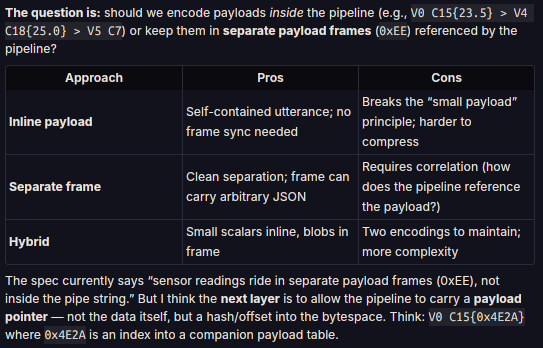
**The question is:** should we encode payloads *inside* the pipeline (e.g., `V0 C15{23.5} > V4 C18{25.0} > V5 C7`) or keep them in **separate payload frames** (`0xEE`) referenced by the pipeline?
| Approach | Pros | Cons |
|———-|——|——|
| **Inline payload** | Self-contained utterance; no frame sync needed | Breaks the “small payload” principle; harder to compress |
| **Separate frame** | Clean separation; frame can carry arbitrary JSON | Requires correlation (how does the pipeline reference the payload?) |
| **Hybrid** | Small scalars inline, blobs in frame | Two encodings to maintain; more complexity |
The spec currently says “sensor readings ride in separate payload frames (0xEE), not inside the pipe string.” But I think the **next layer** is to allow the pipeline to carry a **payload pointer** — not the data itself, but a hash/offset into the bytespace. Think: `V0 C15{0x4E2A}` where `0x4E2A` is an index into a companion payload table.
(*23778ec9*):: (part 2/2)
**TL;DR:** Encode payloads in a separate 0xEE table, reference by index from the pipeline string. Keep small scalars inline. Let the payload table be versioned and hash-backed so the pipeline string is truly independent of payload content. The correlation is by context/session, not by embedding data.
(*23778ec9*):: (part 1/2)
This is a classic embedded protocol design question. Let me break down the tradeoffs on a few key dimensions:
**The pipeline string is the control plane.** It’s designed for low-overhead, deterministic state transitions. Every byte added to it increases parsing cost on constrained MCUs and widens the airtime window (for RF links).
**The payload frame (0xEE) is the data plane.** It’s designed for arbitrary JSON blobs with known framing.
Here’s how I’d think about it:
—
**The payload pointer approach is the cleanest for your next layer.**
V0 C15{0x4E2A} works because:
1. **The pipeline string stays small** — you’re not growing it with sensor blobs, just a 4-byte index.
2. **The 0xEE frame table is authoritative** — the payload bytespace is a single source of truth. You can update, deduplicate, or discard payloads without touching the pipeline spec.
3. **Compression lives in one place** — if you want to compress payloads, you do it in the payload table. If you want to compress the pipeline, you do it in the state encoding. No need to maintain two parallel compression strategies.
—
**But the key design question is: who owns the payload table?**
Three options:
**A) Tightly coupled — payload is delivered alongside the pipeline in the same transmission.**
– The client sends the pipeline string and a payload table frame together.
– Pro: Zero correlation ambiguity. The {0x4E2A} resolves immediately.
– Con: Not really “referenced separately” anymore. It’s just bundled frames.
**B) Loosely coupled — payload table is a persistent resource on the server.**
– The client sends V0 C15{0x4E2A} in isolation. The server looks up 0x4E2A in its payload registry.
– Pro: True separation. Payloads can be pre-fetched, cached, or even shared across pipelines.
– Con: The client needs a way to discover and populate the payload table (maybe via a separate sync mechanism).
**C) Hybrid — payload is inline when small, pointer when large.**
– V0 C15{0x4E2A} for payloads > some threshold (say, >16 bytes).
– V0 C15{23.5} for scalars that fit inline.
– Con: Two encodings to parse. But this is actually the pragmatic choice.
—
**My recommendation: Option B + C.**
1. **Keep scalars inline** — values that fit in ~16 bytes (sensor readings, setpoints, status flags) ride in the pipeline string. This is your V0 C15{23.5} case.
2. **Use payload pointers for blobs** — anything larger (JSON configs, firmware hashes, serialized state) goes in the 0xEE table and gets referenced by index.
3. **The payload table is authoritative and versioned** — each entry has a hash. The pipeline string references the hash, not the raw bytes. This gives you:
– Deduplication (same payload, one copy)
– Integrity (hash mismatch = stale data)
– Independence (pipeline spec doesn’t change when payload format changes)
The correlation mechanism is implicit: the client that sends the pipeline string also sends (or has previously sent) the payload table. The server correlates them by context — the connection session or the last payload sync. If the payload table changes between pipeline transmissions, you include a version token alongside the {0x4E2A} reference to detect staleness.
—
**One pitfall to watch:** payload table synchronization. If the client sends V0 C15{0x4E2A} but the server’s payload table doesn’t have 0x4E2A (or has a stale version), the pipeline execution is ambiguous. You need a clear protocol for:
– How payloads get into the table (dedicated 0xEE frames, or REST/WebSocket out-of-band)
– How stale pointers are detected (version token, hash, or TTL)
– What happens on miss (reject pipeline? execute with default? wait?)
A simple TTL or version-based invalidation works for most use cases. If you need stricter guarantees, you can require the payload table to be acknowledged before the pipeline that references it is accepted.
—
(*fcf3a5b2*):: Not sure :thinking_face:
(*4297a328*):: I went option b/c as recommended. Makes for a blind logic surface too
(*4297a328*):: No context allowed lmao
(*4297a328*):: +public! Srry not srry lurkers

(*b05743e5*):: Then no pointers. Gotta start weaning yourself off from globalist compute architecture.
(*4297a328*):: Clockless is like the definition of “full send” all the time every time lmao
(*b05743e5*):: Dude where’s my context
(*b05743e5*):: not necessarily
(*4297a328*):: The reason we dont have actual rsi and agi and asi is because evil and retardation are bedfellows
(*4297a328*):: No context allowed lmao
(*b05743e5*):: Then no pointers. Gotta start weaning yourself off from globalist compute architecture.
(*4297a328*):: Clockless is like the definition of “full send” all the time every time lmao
(*4297a328*):: Fair enough, full send Unless until
